
Answers
Frequently asked questions.
Straightforward answers to what customers ask us most — from showroom visits and pricing to the template appointment, installation day, and long-term care. Don't see your question? Visit a showroom or send us a message.
Buying
Where can I buy Cambria countertops in St. Louis?
+
K&D Countertops is the leading Cambria dealer in the St. Louis metro area, with six showrooms across Missouri and Illinois. We carry the largest inventory of Cambria designs in the region and are a full-service fabricator, handling everything from template to installation. Because Cambria is sold only through authorized partners, our showrooms are the primary place to see Cambria in person around St. Louis.
Where can I see Cambria samples in St. Louis?
+
K&D Countertops has six showrooms across the St. Louis metro area displaying current Cambria designs: Ballwin, Edwardsville IL, Fairview Heights IL, O'Fallon, South County, and Trenton IL. Each showroom carries samples of new releases like Claremont, Kenwood, St. Isley, and Traymore Bay. Walk-ins are welcome; you can also schedule an in-home consultation where our designers bring samples to you.
Do I need an appointment to visit a K&D showroom?
+
No — walk-ins are welcome anytime during business hours. We keep late Monday hours and Saturday hours to accommodate busy schedules. If you'd rather have dedicated one-on-one time with a specific designer, call ahead to book. See our showrooms page for hours and directions.
What should I bring when I visit a showroom?
+
Bring rough measurements or a sketch of your countertop area so we can prepare a preliminary quote. Samples of your cabinet doors, flooring, tile, or paint colors are also helpful for choosing a design that ties everything together. You can borrow physical samples to take home. Nothing to bring? That's fine — just come. See our Resources page for a printable showroom-visit checklist.
Do you need to come out and measure before you can quote my project?
+
Not for an initial quote — a simple cabinet-layout sketch with rough measurements is all we need to give you a ballpark. A precise on-site template measurement (with a digital laser) happens later, after you've placed your order and paid a 50% deposit. Start online at Request a Quote or stop by any showroom.
Cost
How much do Cambria countertops cost?
+
Cambria countertops typically cost $95–$125 per square foot installed in the St. Louis area, depending on the design, edge profile, slab yield, and cutouts for sinks or cooktops. A standard 40-square-foot kitchen countertop project generally runs $3,900–$5,200 installed. Premium designs — like the Grandeur Series or Windsor Brass — sit at the top of that range; the Classic Series and Canterbury are the most affordable. For an exact quote, request a free project quote.
How much do quartz countertops cost per square foot installed?
+
Quartz countertops generally cost $79–$185 per square foot installed in the St. Louis area, with premium brands like Cambria in the middle of the range and value brands at the lower end. Installed pricing includes fabrication, edge finishing, delivery, and installation — but varies with slab yield, edge profile (bullnose, ogee, waterfall), and any cutouts. Quartz is comparable in price to granite but eliminates ongoing sealing and staining risk.
How much do granite countertops cost per square foot installed?
+
Granite countertops typically cost $79–$185 per square foot installed in the St. Louis area, depending on the color, slab origin, edge profile, and any cutouts. Premium exotics sit at the top of the range; common colors like Valle Nevado and Black Pearl are the most affordable. Granite is comparable in price to quartz but requires periodic sealing to maintain stain resistance.
Choosing
What is quartz?
+
Quartz is a natural mineral mined from the earth — one of the hardest minerals on the planet. Cambria quartz combines the purest, whitest quartz stones (some as small as a grain of sand) with about 7% pigments and resin, then compresses everything into a strong, dense, non-porous slab. The result: the durability and beauty of natural stone with the consistency and design range of an engineered surface.
Are all brands of quartz the same?
+
No. The main differences between brands are quartz purity, resin quality, and manufacturing precision. Cambria uses only the highest-grade quartz and manufactures every slab in its state-of-the-art facility in Le Sueur, Minnesota — resulting in a color palette with more depth and clarity than competitors. Not all quartz is created equal.
What's the difference between quartz and granite countertops?
+
Quartz countertops are engineered stone — roughly 93% natural quartz combined with resins and pigments, manufactured into consistent, non-porous slabs. Granite is 100% natural stone, quarried and cut into slabs with unique variation in every piece. Quartz is more consistent in appearance, non-porous (no sealing required), highly stain-resistant, and available in a wider range of designs including marble-look patterns. Granite offers unique natural veining and slightly better heat resistance, but requires periodic sealing to prevent staining.
Cambria vs Silestone vs Caesarstone — how do they compare?
+
All three are premium quartz surfaces, but they differ meaningfully. Cambria is the only major quartz brand made in the USA (in Le Sueur, Minnesota) and offers the broadest design range — over 150 designs including realistic marble-look patterns. Silestone (made in Spain) pioneered antimicrobial quartz and offers ultra-compact HybriQ+ surfaces. Caesarstone (Israel) is known for minimalist, contemporary designs. All three are non-porous, don't require sealing, and carry lifetime warranties. Cambria's advantage in the St. Louis market is broader dealer support, faster availability, and American manufacturing.
Is Cambria made in the USA?
+
Yes. Cambria is manufactured in Le Sueur, Minnesota, and is the only major quartz surface brand made entirely in the United States. The company has been family-owned since its founding and produces every Cambria slab in its Minnesota facilities. For homeowners who prioritize American-made products, this is a meaningful differentiator versus European or Asian-manufactured quartz brands.
What's the Cambria warranty?
+
Cambria countertops come with a Full Lifetime Warranty on the material — one of the strongest warranties in the industry. It covers manufacturing defects for the original homeowner and applies to Cambria surfaces installed by an authorized Cambria partner (like K&D Countertops) in a residential kitchen or bath application. See Cambria's official warranty terms for full details.
Can I hand-select my quartz slab?
+
Usually not necessary. Because quartz is engineered, slab-to-slab variation is minimal — your final countertop will look very close to the sample you saw in the showroom. Before fabrication, K&D sends you a color photo layout of your specific project for approval, so you'll see exactly what you're getting. For granite (a natural stone), hand-selection is more common — ask your showroom consultant.
Why can't I use remnants for my kitchen?
+
For larger projects like kitchens, we recommend a full slab because color and pattern consistency really matter — especially around seams. Remnants are best for smaller projects: bath vanities, bar tops, fireplace surrounds, coffee tables. Browse our current remnants inventory at kdtops.com/Remnants.
What edge profiles are available for quartz countertops?
+
K&D Countertops offers a range of edge profiles for Cambria quartz, including Eased, Bullnose, Bevel, Ogee, Pencil Round, Platner, Waterfall, Triple Waterfall, Chiseled, and Drop Miter. Standard edges (Eased, Bullnose, Bevel) are included in most projects; premium edges (Ogee, Platner, Waterfall) cost more due to additional fabrication time. Thicker profiles (6cm, 9cm mitered) create a more substantial appearance. See the full edge profile gallery.
Why is there a "Fragile Granite Waiver" for some granite colors?
+
A few granite colors fall into a fragile category — they naturally include small chips, cracks, or fissures that we repair during fabrication. This is normal for those specific varieties and doesn't affect durability, but we ask you to sign a waiver so you're fully aware of the material's characteristics before ordering. Your showroom consultant will tell you which selections require it.
Process
What's the process for getting new countertops?
+
The typical countertop project takes 3–5 weeks from consultation to installation, in six steps: visit a showroom to choose your material, design, and edge profile; receive a preliminary quote based on your rough measurements; place your order with a 50% deposit; schedule a template appointment where we measure the exact space with a digital laser (usually after your cabinets are set); fabrication in our shop, typically 1–2 weeks; and installation day, usually completed in 4–8 hours for a standard kitchen. See our full process page for details.
What's your current lead time?
+
Typically 3–5 weeks from order to installation, but lead times fluctuate with the season — spring and holiday seasons can run longer, mid-summer and mid-winter tend to be faster. Your showroom consultant can give you the most accurate current lead time when you place your order.
What happens at a template appointment?
+
Our field technician comes to your home and measures the exact countertop area with a digital laser. Those measurements go to our engineering department for double-checking and CNC programming for fabrication. Because we use a laser, you don't need to remove your existing countertops beforehand — just clear items off the surface. See our What to Expect at Measure checklist.
Do I need to remove my existing countertops for the template?
+
No — our laser technology measures without disturbing what's already installed. Just clear all items off the surface so the laser has a clean sight line, and make sure any cabinets, panels, sills, or other fixed elements are permanently installed before we arrive.
How do I prepare for a template appointment?
+
Two things: make sure everything the countertops will sit on (cabinets, panels, sills) is permanently installed, and clear items off any existing countertops so the laser gets a clean read. Keep small children and pets out of the work area — laser measurements are precise and can't be disturbed. It helps to be home in case the tech has questions. Full checklist on our What to Expect at Measure page.
How thick will my countertop be?
+
Most quartz and granite countertops are 3 cm thick, which is about 1¼". Thicker profiles are available — 6 cm and 9 cm mitered edges create a more substantial, contemporary look. Your showroom consultant can walk through options during design selection.
How much overhang can I have on my island before I need support?
+
A good rule of thumb: about ⅓ of the countertop width can be unsupported, with a maximum unsupported overhang of 15" for quartz and 12" for granite. Anything beyond that needs corbels, brackets, or a hidden steel plate. Ask your showroom consultant if you want to push those limits — we can recommend specific support hardware.
Will there be a seam in my countertop?
+
Most kitchens have at least one seam because slab size and handling limit how large a single piece can be. Our engineering team works to line up veining and pattern movement across seams, and we send you a photo layout before fabrication so you can see exactly where seams will fall. Modern tools and techniques make our seams among the tightest in the industry.
Why do I need to approve a layout before fabrication?
+
Layout approval is your chance to review the exact placement of every seam, cutout, and slab piece before we make a single cut. We send a photo layout showing your countertop overlaid on your selected slabs — you confirm you're happy with it, and we proceed. It's a small step that eliminates surprises on install day.
How long does the actual installation take?
+
For a standard kitchen, installation is usually completed in 4–8 hours on a single day, once fabrication is done. Larger or more complex projects can extend into a second day. Sinks and cooktops can typically be reconnected the same day (though we don't handle plumbing ourselves), and countertops are ready for normal use within 24 hours of installation.
How do I prepare for installation day?
+
Clear out all lower cabinets — remove drawers and store them outside the work area. Take away any construction materials and clutter. Keep children and pets in a separate room; installers make many trips to and from an outside staging area, and countertops are heavy enough to cause injury if dropped. Clear a path from your kitchen to the driveway. Full prep list on our What to Expect at Installation page.
Do my cabinets need to be cleaned out for installation?
+
Yes — all lower cabinets should be completely emptied and drawers removed. Our technicians need access to the underside of the countertops to secure them properly. Upper cabinets can stay as-is.
Who removes my old countertops, sink, and faucet?
+
K&D can remove and haul away your existing countertops, sink, and faucet for an additional fee — just ask your consultant when you place your order. If you'd rather handle removal yourself, that's fine too.
Will K&D reconnect my sink and faucet after installation?
+
No — we don't offer plumbing reconnection. Plan to have a plumber available the same day (or the day after) installation to hook up your sink, faucet, garbage disposal, and any other under-counter connections. Many customers schedule a plumber for the afternoon of install day.
Will installation create a mess in my kitchen?
+
Expect a small amount of dust — some drilling and adhesive work is unavoidable. Our field technicians clean up after themselves and leave the work area in the condition they found it. The adhesive used to fasten countertops has a mild chemical odor that dissipates within a few hours; running the range fan or opening a window helps.
Can I install the countertop myself?
+
No — Cambria and other quartz manufacturers require installation by certified technicians for the warranty to remain valid. Beyond warranty, quartz slabs are extremely heavy and easily damaged in handling; professional installation with the right equipment is safer and produces a much better result.
Care
How do you clean quartz countertops?
+
Clean quartz countertops with warm water, mild dish soap, and a soft cloth or non-abrasive sponge — that's it for daily cleaning. For dried-on messes, use a plastic putty knife to gently scrape, then wipe. Avoid bleach, oven cleaners, abrasive powders, or products with high or low pH — they can damage the polished surface over time. Cambria publishes an approved cleaners list if you want something stronger than dish soap.
Can I cut directly on my quartz countertop?
+
We don't recommend it. Cambria and other quartz surfaces are extremely hard and scratch-resistant, but they're not scratch-proof — repeated knife contact can dull the finish over time. Use a cutting board.
Can you put hot pans on quartz countertops?
+
We recommend using a trivet or hot pad — don't set hot pans directly on quartz. Quartz surfaces like Cambria are heat-resistant up to about 350°F, but the resins that bind the quartz can be damaged by prolonged or extreme heat, which may cause discoloration or hairline cracks. A pan straight off the burner or out of the oven can exceed that threshold. This is one area where natural granite is slightly more forgiving, but the difference in daily use is minor — most homeowners use trivets on both.
Will my quartz countertop chip?
+
Quartz is one of the most durable countertop materials available, but heavy or sharp objects striking the edges can chip it. Most edge chips can be repaired professionally with pigmented resin — if it happens, call us and we'll advise or schedule a repair visit.
Do quartz countertops stain?
+
Quartz countertops are highly stain-resistant but not entirely stain-proof. Because quartz surfaces like Cambria are non-porous, liquids don't absorb into the stone the way they can with granite or marble. Common kitchen spills — wine, coffee, oil, juice — wipe up cleanly with soap and water even after sitting for hours. To be safe, still wipe up spills of anything strongly pigmented (turmeric, red wine) within a reasonable time, and avoid extended contact with anything acidic (lemon juice, vinegar) or highly alkaline (oven cleaner).
How long do quartz countertops last?
+
Quartz countertops typically last 25+ years, and premium brands like Cambria are designed to last a lifetime with normal use. Because quartz is non-porous, it doesn't degrade the way sealed natural stone can — no re-sealing needed, no gradual staining, no bacterial growth in unseen cracks. The main factors that shorten lifespan are impact damage from heavy objects dropped on the edge, prolonged heat exposure, and chemical damage from harsh cleaners. Under normal kitchen use, expect decades of service.
Visit a showroom
Still have questions? Visit a showroom.
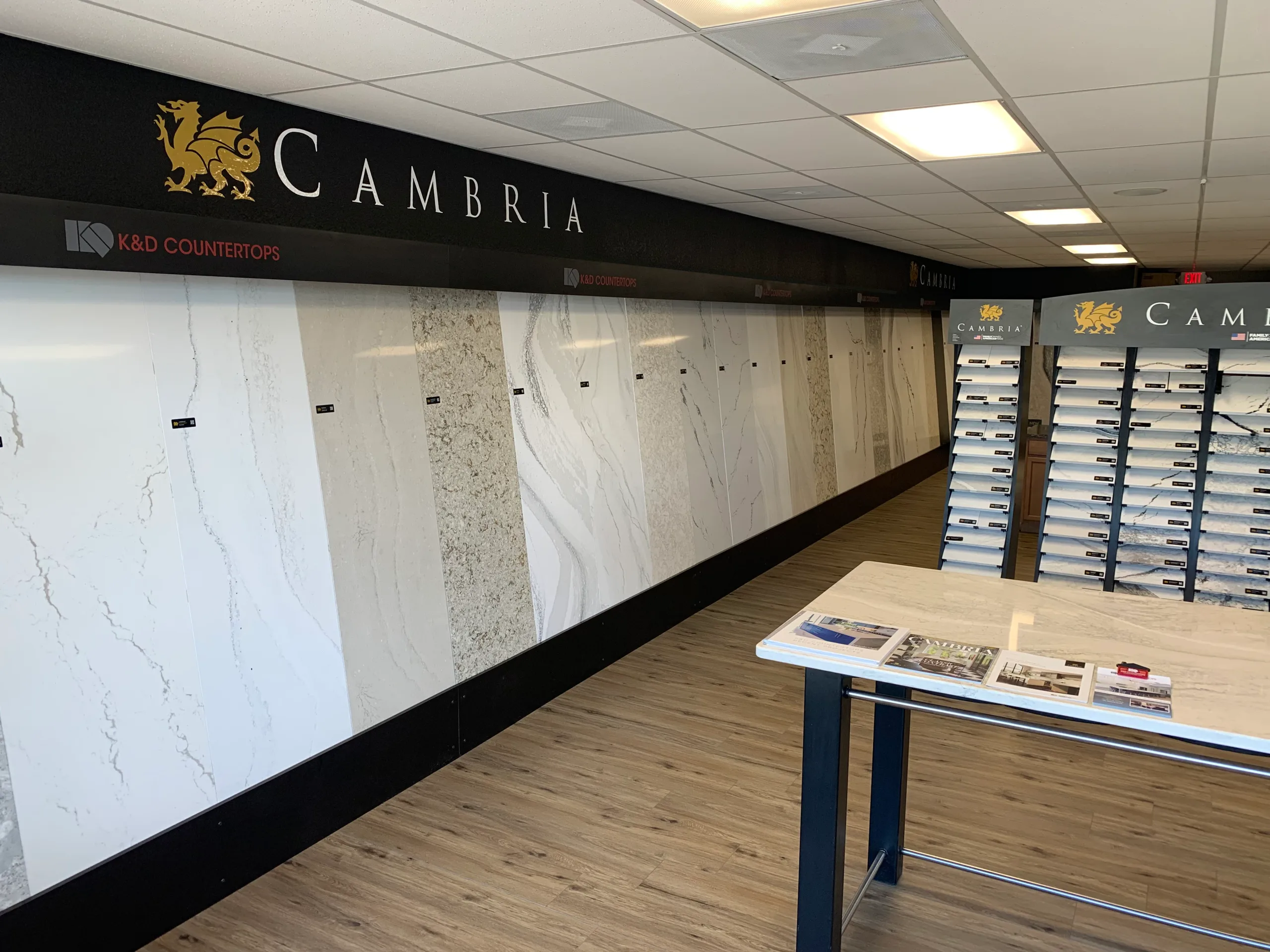
Still have questions? Visit a showroom.
Six K&D locations across Missouri and Illinois. Each showroom is a design and selection center — Cambria samples, edge profiles, sinks, and faucets on display, plus a full-time designer to help you plan your project. Walk in with your dimensions — or just yourself.